
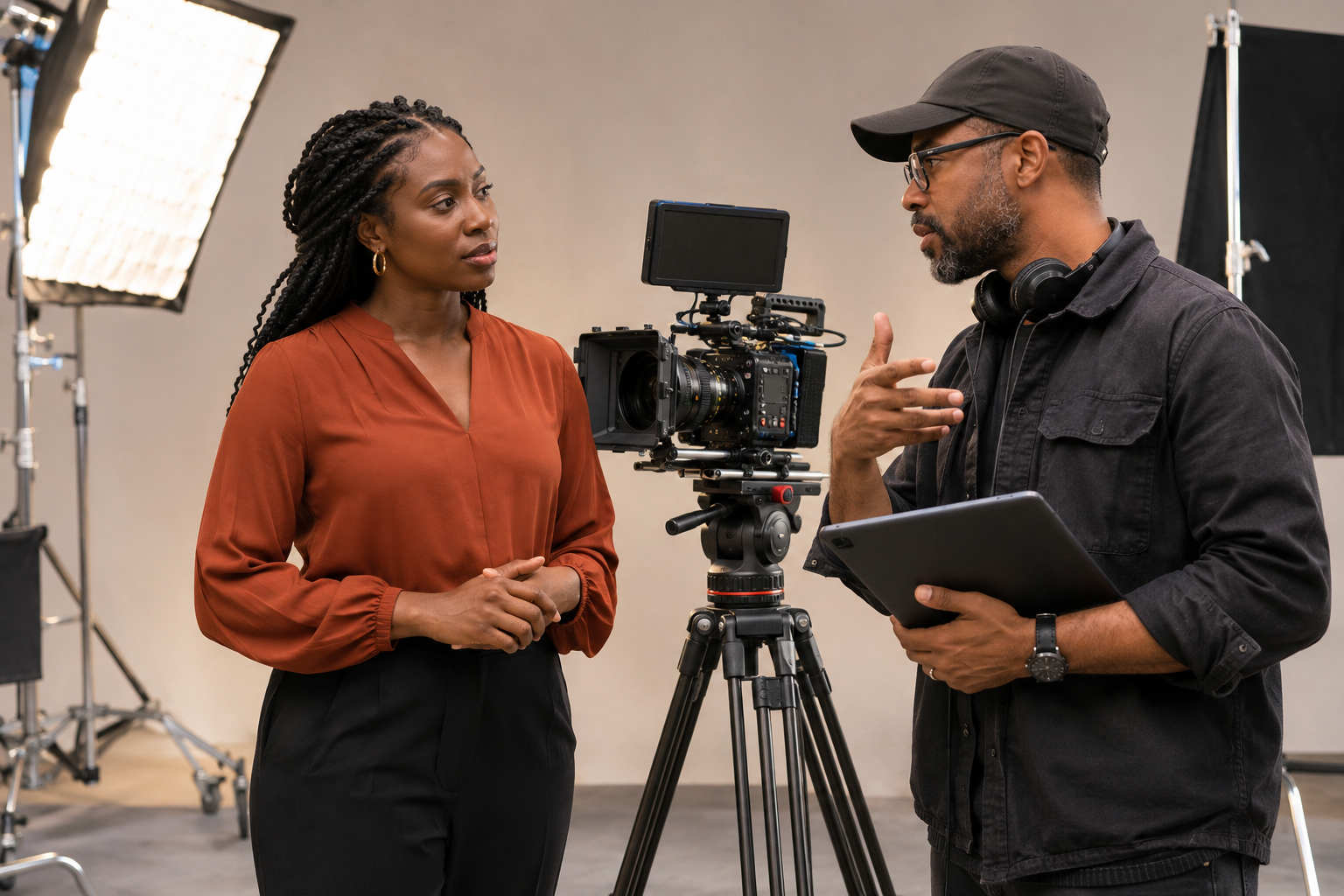
The script is approved. The performer knows the words. Just before the first take, someone asks whether they should look into the lens or toward the person asking the questions.
That is more than a camera-position detail. It asks who the commercial is addressing. Is the performer talking directly to the viewer, answering someone within the scene, or reacting to an event the audience is watching?
For a client, deciding that relationship gives the director and talent something specific to work with. “Make it conversational” leaves several possibilities open. Naming the person on the other end of the conversation helps the team choose a consistent approach.
Start with the intended audience relationship
Imagine a fictional commercial introducing an unbranded appointment service. In one version, an adult performer explains it directly to the person watching. In another, the performer answers a colleague who has asked how the service works. The words could be similar, but the scenes are different.
The direct address includes the viewer in the exchange. The colleague version lets the viewer observe a conversation. Neither is automatically more natural, persuasive or suitable. The choice depends on what the commercial is trying to communicate and how the director plans to tell that story.
State that choice in the creative discussion. If the script is written as a viewer-facing explanation, say so. If the scene depends on another person's question, describe that person and the moment that prompted the answer. This is useful detail for the performance brief, rather than another mood word added to it.
When the concept is still open, keep both approaches identifiable. A client can ask the production team to discuss alternatives without suggesting that the performer should guess which one is intended during the take.
Turn the relationship into a clear eyeline
An eyeline describes where the person is looking. In Michael Bean’s eyeline tutorial, published by Biz Studio in 2013, he explains the concept as the relationship between the actor's eyes and the thing they are looking at. He distinguishes speaking directly to the audience through the lens from looking toward another focus. His tutorial is acting instruction, not a universal specification for every commercial setup.
For the booking client, the useful question is what that focus represents. “Look just over there” may identify a position while leaving the performance unclear. “You are answering a colleague who is interested but unfamiliar with the service” gives the director a relationship to translate into the shot.
Let the director and camera team establish the actual position. The client should describe the intended communication, then review whether the recorded result serves it. There is no need to prescribe a fixed distance beside the lens for every scene or turn a general article into instructions that override the production team.
Keep the direction consistent through the take
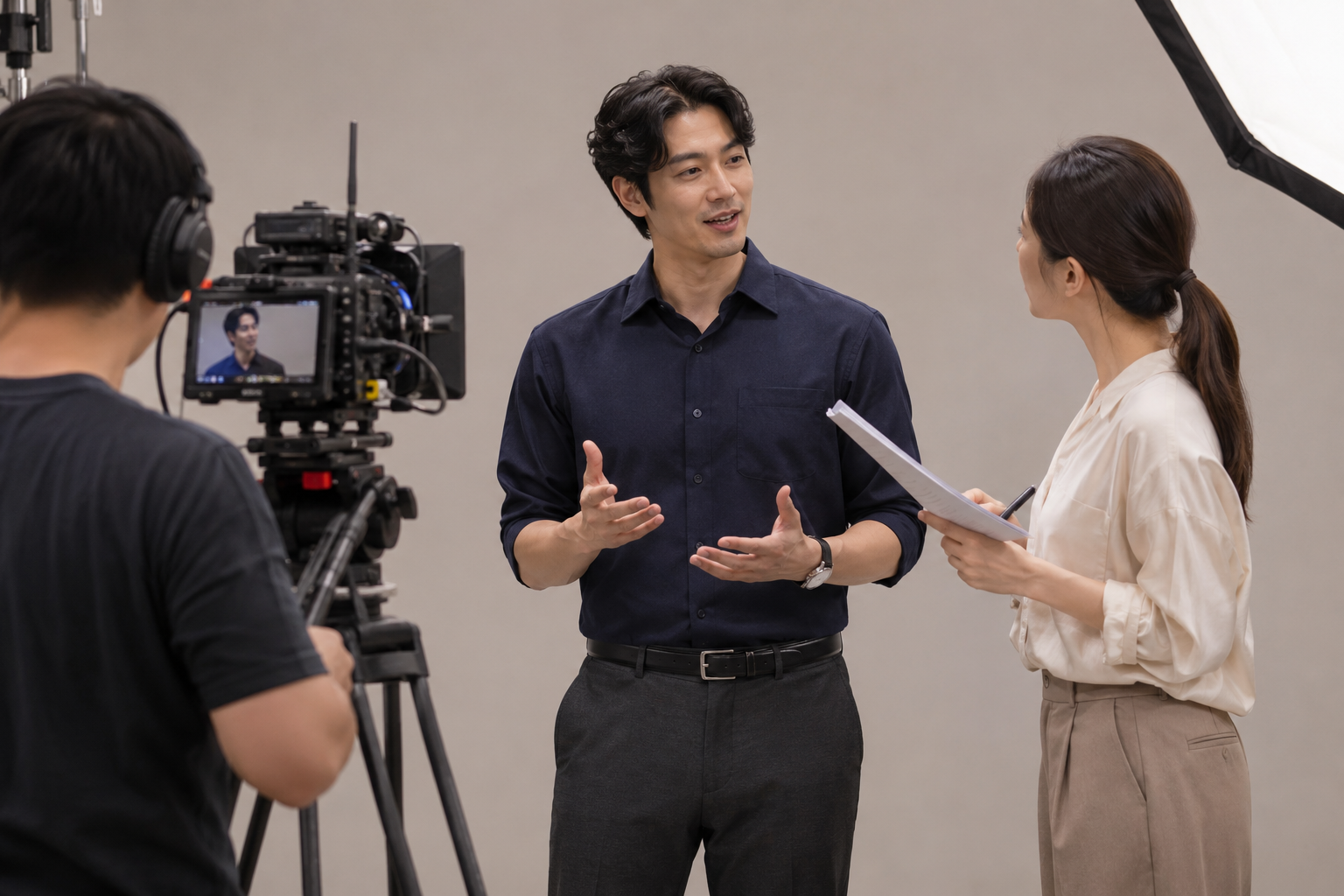
An off-camera conversation needs a clear point of attention. Agree who will provide the other lines or cues, where that person will be and what the performer needs to respond to. If no reader is needed, the director can still establish what the performer is attending to.
The client can help by keeping creative notes consistent. Asking for a spontaneous conversation while repeatedly redirecting the performer toward the lens may be asking for two different relationships. Clarify whether a note concerns the delivery, the gaze or a change in the concept before another take begins.
In the fictional service introduction, “less formal” might mean the performer should sound as though they are answering one colleague. It might instead mean a more relaxed explanation to the viewer. Those are choices to discuss, not interchangeable instructions. Once the team chooses, allow the director to communicate the intended adjustment.
Review the recorded exchange in context. A glance away may belong to the scene; it is not automatically a mistake. Likewise, looking toward the agreed point does not prove that the performance communicates the intended thought. Discuss what the audience can understand, rather than treating gaze alone as a quality score.
Plan both versions for a Las Vegas shoot
For a hypothetical Las Vegas client seeking a short introduction and a longer conversation, identify the addressee for each version before the day is planned. The short film might speak to the viewer, while the longer scene answers an off-camera colleague. Describe both requirements when discussing Nevada on-camera talent.
Ask the production team what needs to change between them. A different reader position, framing or cue may be needed, even if the script and performer remain the same. Do not assume an existing take will serve an alternate audience relationship simply because it contains the right words.

Make the local preparation practical. If the Las Vegas shoot includes a reader or scene partner, identify who is arranging that role and confirm the planned work through the relevant production and talent contacts. If an additional rehearsal is proposed, discuss its timing before assuming it fits the booking. Local representation does not establish availability for extra work.
These are hypothetical planning choices, not descriptions of an In Color Talent project or facility. Their purpose is to make the request clear: which versions are needed, who is being addressed in each, and what production must arrange so the performer can deliver them.
Bring the communication question into the enquiry
A useful brief does not need to solve every camera position. It should let the team understand the intended relationship and identify decisions still open.
When you contact In Color Talent, include the project, role, proposed dates and whether the delivery is intended for the viewer, another performer or someone off camera. If you are considering more than one version, say that explicitly so the casting and production discussion can account for it.
The point is a shared creative decision. Once the team knows who the performer is speaking to, it has a clearer basis for discussing the delivery, the setup and what the finished scene needs to communicate.
AI-generated images illustrate fictional commercial-production scenarios; they do not depict In Color Talent roster members or actual client work.